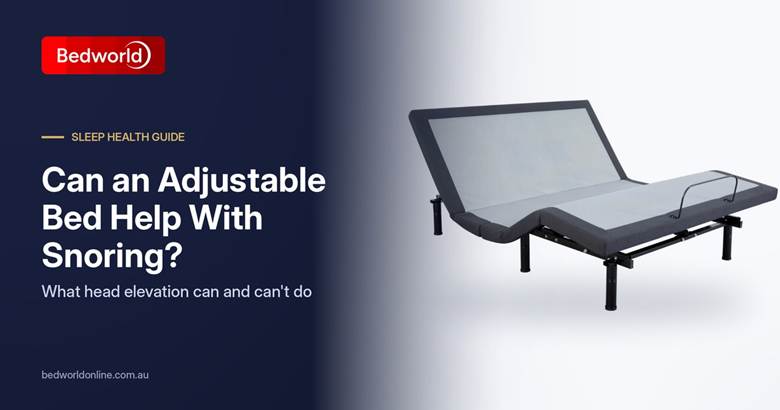
Snoring rarely bothers the snorer as much as the person lying next to them. It’s one of the most common reasons couples end up in separate rooms, and it’s also why “anti-snore” buttons now appear on so many adjustable bed remotes. If you’ve been looking at electric adjustable beds in Perth partly in the hope of quieter nights, it’s worth knowing what raising the head can genuinely do, and where its limits are.
Why People Snore
Snoring is the sound of soft tissue vibrating as air moves past it. When you sleep, the muscles in your throat, tongue and soft palate relax. If the airway narrows, the air speeds up and the tissue flutters.
Lying flat on your back often makes this worse. Gravity pulls the tongue and soft palate backwards, narrowing the space at the back of the throat. That’s why many people snore loudest on their back and more quietly on their side.
Other factors play a part too, including nasal congestion, alcohol before bed, some medications, body weight and the shape of a person’s airway.
What Head Elevation Does
Raising the head and upper body changes the angle gravity works at. With the torso gently inclined, the tongue and soft palate are less likely to fall back and block the airway. For people whose snoring is mainly caused by lying flat, that small change can make a noticeable difference.
An adjustable base does this more effectively than stacked pillows. Pillows bend the neck forward, which can actually narrow the airway. A base raises the whole upper body in a straight, supported line.
What the Research Says
Most studies have looked at obstructive sleep apnoea, a more serious condition in which breathing repeatedly stops during sleep, rather than simple snoring. The findings are still useful.
- In a study of 52 people with obstructive sleep apnoea, raising the head of the bed by just 7.5 degrees reduced the severity of their breathing interruptions without disturbing their sleep pattern.
- A separate study of 45 patients found that elevating the head and trunk to 30 degrees reduced collapse of the soft palate and side walls of the throat, two areas often involved in snoring.
These are small studies, and they don’t mean elevation works for everyone. They do support the idea that a modest incline can help keep the airway more open for some sleepers.
How Anti-Snore Presets Work
An anti-snore preset is simply a one-touch setting that raises the head section a small amount, not the steep sitting angle you’d use for reading. The Slumbercorp Dreamflex 300 Adjustable Bed Base is one example, with a dedicated Anti-Snore preset alongside Zero Gravity and two programmable positions. The advantage of a preset is consistency. You return to the same gentle angle every night without fiddling with the remote in the dark.
A few practical tips:
- Start low. A small incline is usually enough. Raising the head too far can make you slide down the bed or wake with a sore neck.
- Use a thinner pillow. With the base doing the lifting, a high pillow can push your chin towards your chest and work against you.
- Give it a few weeks. Ask your partner to keep a simple note of loud nights before and after so you can judge it fairly.
What Head Elevation Can’t Do
This is the part many product descriptions skip. Raising the head:
- Won’t fix snoring caused by nasal blockage, such as allergies, a deviated septum or a cold.
- Helps less if you snore in every position. Elevation mainly helps people whose snoring is worse on their back.
- Isn’t a treatment for moderate or severe sleep apnoea. proper diagnosis and treatment, such as a CPAP machine or a dental device, remain essential.
- Won’t offset alcohol or sedatives before bed, which relax the throat muscles further.
When to See a GP
Snoring can be harmless, but it can also be a sign of obstructive sleep apnoea. See your GP if you or your partner notice:
- Pauses in breathing, choking or gasping during sleep.
- Waking unrefreshed or feeling very sleepy during the day.
- Morning headaches or trouble concentrating.
- Loud snoring most nights, even after lifestyle changes.
Your GP can refer you for a sleep study if needed. In Australia, the Sleep Health Foundation also publishes reliable, plain-language information on snoring and sleep apnoea.
A Note for Couples
If only one of you snores, a split base can be the most practical setup. Two long singles on a king-size split base let the snorer sleep slightly raised while the other partner stays flat. It’s often a better compromise than separate bedrooms.
Frequently Asked Questions
How much should I raise the head to reduce snoring?
A gentle incline is usually enough, rather than a steep sitting position. Start with your bed’s anti-snore preset and adjust from there until you’re comfortable.
Is an adjustable bed better than a wedge pillow?
An adjustable base raises your whole upper body evenly and can be changed at the press of a button. A wedge is cheaper but fixed, and some people slide off it during the night.
Can an adjustable bed cure sleep apnoea?
No. It may reduce symptoms for some people with mild, position-related apnoea, but sleep apnoea needs proper medical assessment and treatment.
Will elevation help if I sleep on my side?
Side sleeping already reduces snoring for many people. A slight incline may help a little further, but the biggest gains are usually for back sleepers.
Conclusion
An adjustable bed can be a genuinely useful tool against snoring, especially for people who snore most on their back. A modest head lift helps keep the airway clearer, and a preset makes it easy to use every night. It isn’t a cure for every kind of snoring, though, and it’s no substitute for medical advice when snoring comes with breathing pauses or daytime tiredness. Used with realistic expectations, it can make bedtime a lot quieter for both of you.